Tuesday, February 10, 2009

Getting into Fishing

Updates have been slow lately, I apologize. I seem to be able to update and think about this whole thing a lot better when I am reading some sort of practical sailing book. I am currently into The Long Way by Bernard Moitessier, and while it is a fantastic read, it is more of a story and not an instruction book. It is working wonders on my imagination and desire to go sailing, but not teaching me much.

One thing I have started to get into, however, is fishing! I had mentioned previously that while I am cruising I would like to be able to provide as much food for myself as possible by fishing and collecting. I have fished plenty of times throughout my life in lakes, rivers, the beach, and deep sea. But that was all with either my dad or some sort of instruction. I pretty much only had to bait the hook, cast or drop, and catch the fish. Never did I learn the subtleties of the equipment, what bait to use, and what I was trying to catch. So as a major skill I plan on using during the journey, its about time I learned more about it. My roommate and some other friends have been getting heavy into fishing for the past year so I had a good reference to start with.

As a coincidental primer to get myself into fishing, I had a trip planned to go up to see a friend in Connecticut to do some ice fishing. This was more of a "bucket list" thing just to say we did it, but I began to get really stoked on the idea and wanted to catch a big one. We made our way up to the north hill country of Connecticut early in the morning a couple of Saturdays ago and met up with our guide. Ended up at a place called Twin Lakes, one of which Merrill Streep supposedly owns all land around. Once we arrived we had to hike about a mile out onto the lake to the fishing spot. The weather was clear with a little breeze, a toasty 7 degrees.

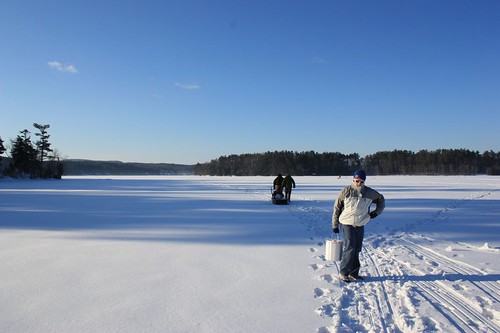




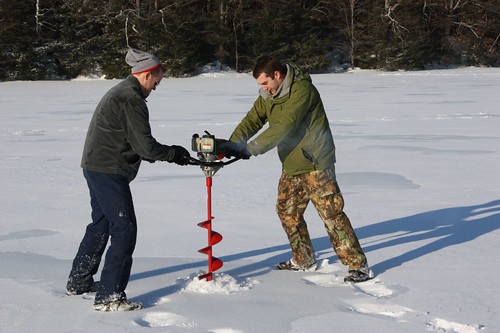
Once we were out there our guide, Marty, showed us how to do the deed. First we drilled holes down into the ice in a line spaced apart by a about 10 yards.


After that we would take a depth sounding at each hole and drop the line in with some bait at the appropriate depth. The line is attached to a gizmo that pops a flag up when the line is pulled by the fish. So you set all of these traps and watch for flags to pop up then run across the ice to see what you caught.
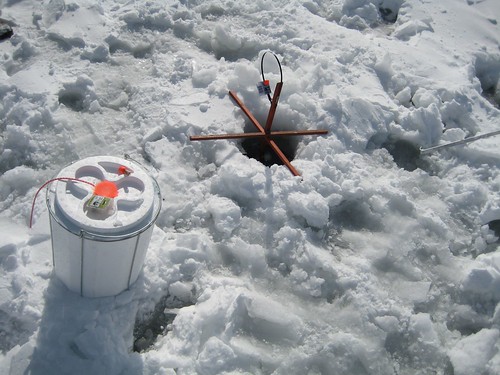


We also put in some rods to hand fish. What we didn't notice when we were walking out there that there was about 4 inches of water between the snow and ice. This was from rains the previous week, and it made for very wet boots and socks. Some of the guys were wearing regular running shoes and cotton socks which nearly gave them all frost bite. 4/6 of us had to spend most of the day in the car, but I was able to stay out with my good hiking boots and wool socks. In the end we only caught one little brown trout and weren't allowed to keep it. While the fishing may have been disappointing, I am glad I was able to go and experience it all.


Marty cooking breakfast
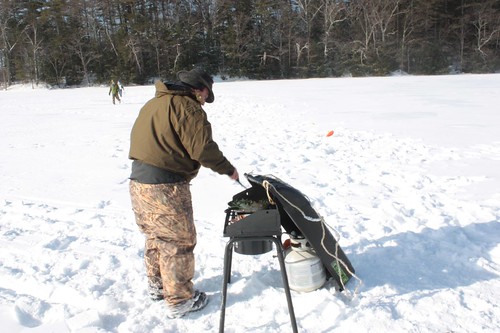


Me!


This past weekend we went camping out on the beach to do some surf fishing. I picked up a 10 foot surf combo from Wally World. Everyone in there seemed to give me a bright smile and nod while I had the pole in my hand. All of the goodwill received there must have had something to do with how the rest of the weekend went. My pole was the only hot one of the group, first catching a small Whiting:

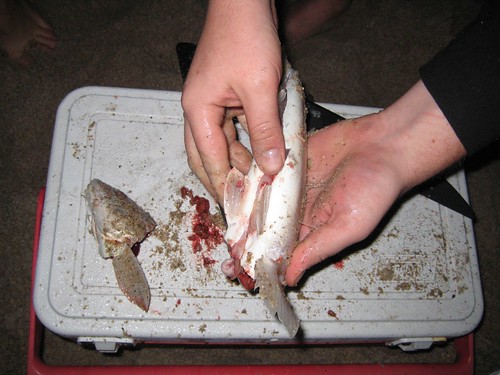


We cut up the fillets for cooking, and used the rest as bait. The meat was delicious and I was reminded how good fresh fish is. We next hooked a small blue fish on my pole and used it for bait as well.



It was pitch dark at this point and we could barely see our poles from the camp site. I was staring at them hard at one point and could not find my pole anywhere. I ran down to see it laying down and dragging a little bit. I picked it up and found that something was hooked and fighting hard. I yelled to the group that a fish was on and started to reel it in. No one ran down to come help so I yelled up again in a more urgent tone to let them know I was serious. They all thought I was just caught on a line or screwing it up somehow. I fought the thing for what seemed like a while, and my shoulder was burning by the time it got close to the shore. One of my buddies finally came down to see what was up right then the fish became visible in the water. Immediately we started jumping up and down screaming after we saw the hog that I was reeling in. All of the others ran down at the sound of that. Lo and behold, I pulled in a ~40 pound Red!!
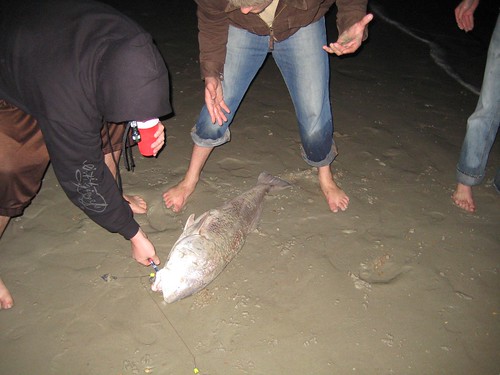
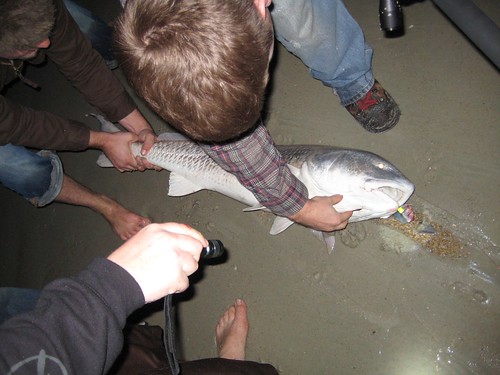


According to my friends and everyone else we showed it to, it was a monster catch, something people work their whole lives to get. I felt lucky and unlucky at the same time. I caught a winner on my first go out, but will it all be downhill from here? Who knows, either way I am hooked (pun intended)! We had to release it because it was too big and too old to eat. I struggled to get the thing to swim again but eventually he was revived.

So there begins my journey as a fisherman. I can't wait to do more surf fishing while I am out at the beach. I am out there surfing enough, might as well start to catch dinner while I am doing it. I plan to learn how to spear fish, collect lobsters/crustations, and all other manners of harvesting food from the sea. Cant wait!

Tuesday, January 27, 2009

Boat Criteria pt 2

Now that I have narrowed the boats down to some brand names and broad needs, I need to start figuring out the specific things I need and want in my boat. The first thing the boat needs to be is bluewater capable. In this post I will start to outline the things that the boat needs to be a safe bluewater boat. These characteristics are the ones that separate a successful offshore voyager from a coastal cruiser. I will develop these lists as time goes on and have estimates of costs for each major upgrade that I may come across. That way, I can evaluate potential boats and compare them to each other to find which is truly the best deal. Most of these are design related but many are upgrade/equipment related so the boat may be upgraded to include some of these.


Cockpit
-Small cockpit that drains quickly
-Should be able to sit at least 6 people
-Bridged deck or high sill to prevent a boarding wave from going below
-Drains need to be large enough to drain the entire cockpit in 2 minutes or lesss
-If there is a wheel, at least 18 inches of standing room behind it and a way to brace feet
-Seats should be long enough to lie down and close together enough to brace feet.
-Lockers should be watertight, reasonably sized, well secured, and fully protected by combings. Ideally, lockers should not communicate directly with spaces below and should drain overboard
-Well ventilated hard dodger or some sort of shading.

Decks
-Good nonskid surface
-Wide, unobstructed deck from bow to stern. Side deck at least 18 inches wide.
-Strong handholds always within reach
-High toe rail or bulwark that does not trap water
-High lifelines and strong stanchions. Lifelines at least 28 inches high.
-Enough space to fit at least two full surfboard bags on deck while sailing

Anchoring Platform
-Two large, properly designed anchor mounts
-Anchor mounts should be far enough forward of the stem so anchors cannot swing into the topsides
-Bow rollers at least 3 inches wide, turn easy under pressure, fit snugly in the anchor mount without binding.
-Two ore more big, stout cleats with proper fairleads.
-Large windlass with both rope and chain gypsies. (more important in boats over 35 feet)
-Solid bow pulpit
-Enough storage for adequate chain, preferably not in the foredeck

Galley
-U-, G- or aisleway galley layout for adequate bracing and footholds.
-Gimballed propane stove that can be locked in place, 3 or 4 burners. Able to swing freely to a 30-degree angle in either direction. Needs crash bar.
-Deep double sinks as close to the centerline as possible. Minimum 8 inches deep. Might be hard to find double sinks on boats under 35 feet.
-Accessible lockers with high fiddles. Sliding doors preferred.

Bunks
-All berths at least 6'4". (I am 6' and it says to have a minimum 4" above the tallest person)
-20-24" wide for sea berths
-At least 2 sea berths parallel with the boat's centerline as close to amidships as possible.
-No curved settees
-Berths need lee cloths
-Would like to have a pilot berth

Handholds and Footholds
-Cabin sole needs to be made of good nonskid material like teak, holly, oak, or with nonskid coating
-Should be able to reach handhold from any point in the interior when heeled over.

Stowage & Accessible Space
-Many small compartments with adequate offshore storage
-Locker doors and drawers must all lock securely
-Drawers should be notched on the bottom so they have to be lifted to open
-Small block on back edge so drawers can't be opened all the way.
-Great engine access space
-Good plumbing access to every tank, through-hull, and seacock.
-Access to entire bilge stem to stern
-Well constructed bilge channels
-Bilge must drain to stern without trapping water along the way
-Bilge drainage must work on any angle
-Deck fittings should be easily accessible from below

High Quality Engine Installation
-Engine should be mounted over a solid fiberglass or metal engine pan
-Bolted to mounts which are in turn glassed to structural frames
-Diesel tank should have a sump

Weatherproof ventilation
-Large opening hatches, one for each major living space
-Minimum four large dorades (35 feet +)
-Ventilation will probably need to be upgraded for tropical cruising

Watertight Construction
-Strong, commercial, ocean-rated hatches with structural crosspieces supporting the Lexan or acrylic and either set on plinths above deck level or protected by wavebreaks
-Ocean-rated opening portlights installed so they drain onto side decks instead of pooling ater at the bottom of a port
-Properly constructed companionway which includes a watertight seahood surrounded by drainage channels
-Fully weatherproof door or strong, easy to use hatchboards that can be fixed in place at sea
-Strong, positively locking hatches for deck and cockpit lockers with cahnnels around them to drain seawater
-Hull to deck joint built with overlapping flanges or completely glassed over with several layers of fiberglass
-Stanchion bases mounted on solid toe rail or on solid fiberglass pads raised above deck level to keep them out of water pooling on the deck
-Solid stainless steel backing plates installed wherever bolts go through the deck
-A watertight way to seal the hawsehole at sea
-Ultra-high-molecular-weight polyethylene rudder bearings
-Dripless stuffing box
-High-quality bronze (Marelon for metal boats) seacocks
-Double stainless steel hose clamps on all drainage, engine, and plumbing hoses

More to come!

Friday, January 16, 2009

A Boring Week

It is hard to think of things to write about when I'm not reading a sailing related book. I finished all of the ones I own and have a few more coming. Until then, you may just have to deal with my ramblings.

This weeks accomplishments toward the dream has been more of the same: finding ways to save more cash. As mentioned previously, I finally have more cash than credit card debt, but I still need to pay it off. I want at least $2,000 in the bank above and beyond the balance of my credit cards for emergency cash. I think I can be at that point by mid February, and my last estimation was for March so I may be able to beat my target. This will be a huge day for me because it marks the day I can start to count my money towards the boat. Right now I am at a negative number in terms of savings for the boat, that day will finally show a positive one. I am reaching for that home stretch and finally get the debt behind me. I am trying to eat & drink cheap, not spend too much on entertainment, and driving very little. Almost there.

Once that day happens it is serious boat search time. I've been collecting all of the best boat search websites and assembled the list of boats I am looking for in the previous post. I do searches here and there and find many potential boats. But once I reach positive savings, I will start to seriously look at some of the ads and begin to go see boats. If I find a good boat at the right price, I am going to get it and not worry anymore about taking a loan on it. I plan to move onto the boat so basically my rent will be the boat payment. I will be able to begin to learn about my boat, outfit it, learn how to sail, and save money by living aboard. Can't wait till that day.

Tuesday, January 13, 2009

The Boat List

So now that I have some criteria, we can look at some specific models. I have been doing plenty of searches throughout the net and around my area and have a good idea of the type of boat I need to narrow it down. But to keep myself on track, I have been using a list developed by Mahina Expeditions and the cruisers who post on Sailnet.com. The list includes all known SEAWORTHY boats. It excludes those who have known full-time cruising deficiencies. The original list can be found here. The list below is chopped to only show the boats in my size range.

Whenever I am searching for boats, if it ain't on this list, I will skip it. If any of my friends or family come across a boat for sale and think "I wonder if this would be good for Erick?", consult this list. If it is within my budget...LET ME KNOW ABOUT IT! It should be noted that any of these designs that are bigger than the models listed here will probably do as well.

Here is the list:

  • Able 32 * USA Superb quality, expensive. Chuck Paine designs.
  • Alajuela 33 * USA Good value, well built
  • Alberg 30, 35 * USA Early f /g boats. Well proven, not expensive.Narrow, short waterlines, graceful overhangs.
  • Alden 38 * USA Classy, well built, beautiful & expensive.
  • Allied 30, 32, 33, 35, 36, 39* USA Good value. Functional, practical.
  • Amel 36 * FRA Strong, well designed. Excellent passagemaker, great value. Low maintenance.
  • Amazon 29, 37 * CAN Steel boats, attractive modern designs.
  • Annie 28 * USA Every boat built by Morris is a work of art!
  • Aries 32
  • Bayfield 29, 30 32, 40 * CAN Good value. A bit “plasticy” interiors but ok.
  • Bowman 36 * ENG Strong boats. Excellent passagemakers.
  • Bristol 27 * USA Good boats. Later models were better quality.
  • Bristol Channel Cutter 28 USA Well built, not my personal choice. Good company.
  • Cabot 36 * CAN Ted Brewer design
  • Cal 30, 34, 36, 39, 40 * USA Bill Lapworth designs. Many 2-46’s have circumnavigated.Comfortable, reasonably priced but look very carefully at bulkhead attachment.
  • Caliber 28, 33, 35, 38, 40 USA Fairly well built. Michael McCreary designs.
  • Cambria 40 * USA Fast, well built, gorgeous and expensive.
  • Camper Nicholson 31, 32, 35, 38, 39, 40 * ENG Out of business except for shipbuilding. Watch for serious blister problems on all models.
  • Cabo Rico 34, 36, 38, 40 *CRI Crelock and Paine designs. Expensive, semi custom.
  • Cape Dory all models * USA All models are well designed & built.
  • Cape George Cutters 31, 36, 38 USA Some owner completed. Strong & fast. Sometimes great value.
  • Cascade 36 USA 1965-67 design still being built. Narrow. Many owner-finished.
  • Centurion by Wauquiez (not Beneteau) 36-59 FRA Centurion’s built before Wauquiez sold to Beneteau are solid, but w/limited tankage. Later Beneteau-built models are not appropriate or impressive except for dockside living.
  • Contessa 26 & 32 * CAN, ENG Tania Aebi & B.J. Caldwell both circumnavigated in 26's.
  • Contest 31, 35, 36, 38, 40 HOL More common in Europe. Well built, new boats are very attractive.
  • Corbin 39 * CAN Roomy and strong, but watch for hull blisters.
  • Crealock 31, PH 32, 34, 37, 40 by Pacific Seacraft * USA Good value and well built. Graceful overhangs, canoe sterns, short waterlines means these boats may hobbyhorse upwind.
  • CS36T
  • CSY 37 * USA Sturdy, roomy & reasonably priced but old.
  • Deerfoot Yachts * Var Fast & innovative, aluminum & fiberglass hulls.
  • Dickerson 36, 37, 40 * USA Nicely proportioned & well built boats. Earlier 36’s are very reasonably priced.
  • Downeast 32
  • Endurance 35, 38, 40 * Var Peter Ibold design, some owner completed. Built by various yards in ENG, USA & Canada.
  • Esprit 37 by Nordic * USA Perry design. Comfortable, well proven, good value.
  • Fast Passage 39 USA Some built in Canada, some by Tollycraft. WA. Excellent boat.
  • Freya 39 * USA Good value. Many owner-completed, so quality varies. FAST, full-keel design capable of 200 mpd!
  • Fuji Fuji 32
  • Gladiateur 33 * FRA Very sturdy, short on tankage, Waquiez built.
  • Goderich 35, 37 * CAN Attractive Brewer steel boats. Short production run.
  • Gozzard 31, 36 CAN Good design & construction. Totally committed quality company.
  • Hallberg-Rassy, 31,312,33,35,352,36,38,382,39 SWE
    Well built, comfortable, with good tankage & storage. Newer Frers designs have better
    sailing performance than earlier Enderlien boats. Excellent resale value. Excellent
    systems integration and detail.
  • Halmatic 30 * ENG Similar to Nicholson 31. Watch for blisters.
  • Hinkley 30-64 USA Attractive, highest quality, and expensive. Hold their value well. Modest tankage & storage.
  • Hood 38 * FRA Waquiez built, Hood design. Strong, fast, & attractive. Short on tankage.
    Centerboard rattles downwind. Solid choice
  • Island Packet 32, 35, 350, 37, 38, 40 USA Roomy & comfortable with good tankage & storage but some odd features. Continually improving. Good value, exc. company.
  • J-Boats/32, J/42 USA Fast, light. Excellent sailing performance. Minimal tankage and storage. Fast downwind, pound heavily upwind. Ck keels!
  • Jason 35 from Miller Marine * USA Some owner completed. Several have cruised extensively.
  • Justine 36 * USA Gorgeous Paine design, Morris built cruiser.
  • Kaiulani 34, 38 * USA Lovely steel Brewer & Yohe designs. Very limited production.
  • LM 27, 28, 290, 30, 315, 32, 380 DEN Some have inside steering. Well built and impressive.
  • Linda 28 * USA Gorgeous design, Morris quality.
  • Leigh 30 * USA Very well built, attractive Morris.
  • Luders 33, DOVE * USA Older, well built by Allied.
  • Malo 36, 38, 39 SWE Quality offshore boats with good sailing performance. Attractive, reasonably priced. Strong company, good service.
  • Mariah 31 * USA At least one circumnavigation. Pacific Seacraft built.
  • Mason 33 * TAI Some of the very best Taiwan built boats.
  • Mercator 30 * USA Inexpensive, obscure. One has circumnavigated
  • Moody 38 * ENG Good designs but some quality-control issues.
  • Morgan 382, 383 * USA Excellent Ted Brewer design for around $60K.
  • Morris 26, 28, 30, 32, 34, 36 USA Chuck Paine design. Superb quality, highest quality US yard building cruising boats. Expensive. Semi-custom.
  • Najad 330, 361, 370, 390 SWE Quality, attractive boats. Excellent sailing performance. Good tankage, storage and high level of craftsmanship.
  • Niagara 31, 35 * CAN Well built & roomy. Superb value.
  • Nordic 34, 40 * USA Attractive boats, some solvable problems with mast step deflection on the 40 & 45.
  • Norseman 400 * TAI Strong, fast, and attractive. Have held their value well.
  • Orion 27 * USA Offshore capable. Pacific Seacraft built.
  • Pacific Seacraft 34, 37 * USA Well built boats, good resale. Graceful overhangs.
  • Pearson 35, 365 * USA Fairly well built, not flashy but reasonably priced.
  • Passport 40 TAI Modem Perry cruising design. Good storage/tankage.
  • Pretorien 35 * FRA Strong, fast & attractive. Built by Waquiez. Best value for a boat under $85,000. Modest tankage.
  • Rafiki 37
  • Regina of Vindo, 38 SWE Attractive, well built, quality deck saloon. In a class of their own for quality and design.
  • Rival 36 * ENG Strong, good-looking and sailing boats.
  • RobinHood 36, 40
  • Rustler 36 ENG Totally impressive, quality boat and company.
  • Sabre 34, 362, 38, 402USA Built in Maine, great quality, but limited tankage and storage.
  • Sadler 34 * ENG Unsinkable, fast, great performance. Good choice.
  • Saga 35* CAN Modern Perry design. Fast innovate and narrow. The 43 is a very tried and proven design.
  • Saturna 33 * CAN Attractive, Bill Garden designed pilothouse cutter.
  • Scanmar 35 * SWE Limited production but good design.
  • Seawind 30, Seawind II 32’ * USA Excellent boats. Good value. First. Built by Allied Yachts
  • Shannon 32, 36, 38, 39 USA Good reliable boats. Hold their value well.
  • Southern Cross 28, 31, 35, 39 * USA Good boats. Attractive designs. Fairly well built.
  • Spencer 35 * CAN Older, solid boats, built in Vancouver, B.C.
  • Shearwater 39 RSA Strong, traditional and attractive.
  • Tayana 37
  • Tartan 3500, 37, 3700 * USA Well proven several 37’s have circumnavigated. Some designs have centerboards.
  • Tashiba 31, 36, 40 * TAI Perry designs. From the best yard in Taiwan.
  • Trintella HOL Roomy and well built. Newer designs are aluminum and exp.
  • Triton 29 by Pearson * USA Good value, sturdy. Earliest F/g production boat.
  • Valiant 32, 37, 39, 40 nUSA Major blister problems on Valiant 40 hull numbers 116 250. No problems with any of the excellent Texas built boats. Proven designs, strong company.
  • Vancouver 27 * CAN Also built in Taiwan & England.
  • Vangard 32 * USA Good value. Phil Rhodes design, built by Pearson
  • Vega 27, by Albin Marine * SWE At least six have circumnavigated. Inexpensive, fast.
  • Victoria 30, 34 ENG Chuck Paine design, Morris built.
  • Vindo 29, 34, 38, 39 SWE Attractive, well built, but high maintenance.
  • Vineyard Vixen 30, 34 * USA Attractive design.
  • Willard 8 Ton
  • Westerly 26 36 ENG Not flashy, but fairly well built boats.
  • Westsail 28, 32, 39 * USA Sturdy boats. 39’s are rare & attractive. Perry design.
  • Yankee 26, 30 * USA S & S designed. Inexpensive and capable. Great value.


Monday, January 12, 2009

Boat Criteria

Now we have come to the big discussion of the boat that I need to get this thing going. Thousands of magazines and books devote millions of words to describe the "perfect" offshore yacht. I, however, cannot afford the new boats reviewed in the pages of marine magazines. I must find a capable, seaworthy boat that fits my budget. In the world of cruising boats, my budget is quite small.

In the perfect world, I would get a brand new, custom cruising Catamaran in the 50 foot range like the one pictured here. Able to handle whatever weather is thrown at it, cruise fast across the open oceans, have plenty of storage for surfboards and other gear, and plenty of room for a half dozen of my closest friends. This will have to be my lottery winnings boat.

To narrow the field, I'll use some exploratory questions:

  1. What type of boat do I want?
  2. Where do I intend to cruise?
  3. What size of boat will suit me?
  4. What age boat will suit my budget?
What type of boat do I want? Well this is an easy question to answer because my choices are limited by my budget. I should start by saying that a mono-hull is my first criteria because as much as I would want a catamaran, I cannot afford a multi-hull. There are many mono-hull boat designs to choose from including traditional voyagers, performance cruisers, and the more modern racer/cruisers and cruising sleds. All of these except the traditional voyagers are out of my price range, with a few exceptions in the performance cruiser category.

Traditional voyagers are characterized by being slow, but safe and comfortable. They typically have a large keel area and heavy displacement to dampen motion in a seaway. Traditional voyagers take care of their crews and are comfortable even in a blow. The biggest downfalls are speed, especially to windward. They are sluggish under power, difficult to move in a marina, and nearly impossible to back up in a straight line. All of which do nothing to discourage me!

Boats in the other categories have less keel area to make for better performance. To compensate for seaworthiness, they make them bigger. The bigger the boat = more money. Therefore, to afford a seaworthy boat, I need to look at the older, more traditional voyagers. Fine by me, most old sea salts swear only by full keeled boats and I will trust them.

Where do I intend to cruise? Different cruising grounds offer different challenges. A boat well suited to high-latitude cruising may not do as well in the tropics. For my voyage, the majority of the time will be spent cruising in the tropics. This is something I can plan on and make good judgment calls about my purchases because of it. I do not intent to explore the higher latitudes just yet, maybe later in life when surfing is less of a priority.

For a tropical voyage with the prevailing trade winds, a boat needs to sail well downwind. It should be stable and easy to steer when running dead downwind and have a variety of downwind sail combinations for everything from light to gale-force winds. If the crew is to stay cool in the tropical heat and humidity, the boat needs to be protected from the sun. Shoal draft (less than 5 feet) is a big advantage in a handful of cruising areas like the Bahamas. High latittude cruising requires a boat able to handle a much wider range of conditions, therefore adding to the crap it needs. From what I have found, I will be able to save money by getting a boat intended for tropical cruising over high latitude cruising.

What size off boat will suit you? Well I don't think I need to worry about a boat that is too big. May boat buyers are rich and want the biggest, and that isnt necessary the best. Bigger boats are harder to handle, harder to find a place to anchor, and need much more cash in the bank to maintain. Too small of a boat, however, is something I needed to figure out. The conventional wisdom is that 30 feet is the smallest you should consider for a sea-worthy vessel. Any smaller may not handle the demands of the sea, and will not have enough storage. However, I just fininshed The Self Sufficient Sailor and they circumnavigated on a 27 footer, so it is definitely possible. But with the style of cruising I plan and the gear I plan to bring, I am putting the minimum at 30 feet.

The only thing I really need to consider when it comes to size is storage for surfboards. The board bags are big and bulky and will get in the way on any small sailboat. So I will definitely be seeking the biggest boat I can afford. After searching, they start to get too expensive after 40 feet, and I can't see myself needing a boat that big anyways. So for my boat search I am looking at everything between 30-40 feet.

What age boat will suit your budget? The answer is: Old. I can't afford anything build in the past two decades, so I usually don't bother looking. But as the age of the boat goes up, so does the percentage of the cruising budget that must go into refitting. I am expecting to pay at most 100% of the purchase price into refitting the boat. I can expect to find a quality vessel made around the mid 80's or earlier to be in my price range. I will aim for as new as I can, especially considering some things I have read about the improvements in boat hulls in the early-80's.

So now we have a good list of criteria for my boat, and this is how I do my searches:
  • Between 30-40 feet in length
  • Traditional design with full keel or modified full keel with skeg rudder
  • Priorities: Lowest possible total cost for seaworthy boat, simple as possible to minimize costs, excellent stability.
  • If I need 100% of the boat costs budgeted to refit then my boat budget is $20k with $20k for refitting. So the idea is to find a boat in my size range and style with the "best deal", i.e. the biggest, newest, safest boat with minimal refit needs within my budget.

Friday, January 9, 2009

Little investments

In my effort to finally get out of bad debt and begin to pad my savings for boat money, I have started to sell some items that I no longer need. One of these was my home gym that I purchased last year second hand from Craigslist. The original idea was to save money from the gym membership and I accomplished that. I only paid $200 for the full gym and it did everything I needed. Since then I began to play soccer regularly and that has done more for my fitness than lifting ever did.

Yesterday I sold the gym for $400 yielding a 100% return woohoo! A little investment like that is something easily possible on Craigslist. When I am in the market for something, such as the gym, I wait till I find some guy who is moving and needs to get rid of the item fast. Ususally they have rock bottom prices and you can even haggle them lower. If most of the other comparable items are going for a higher price, you found arbitrage! Try it sometime, you may make some cash.

Another example is my hot tub. Last year I decided it would be extremely fun to have a hot tub at the house. I wasn't willing to throw $4,000 into it as I had begun to be wise with my money by then. But I did keep an eye on Craigslist until I saw a perfectly working hot tub for only $900. It was only a year old, fully under warranty and sells new for $4,000. Most other tubs listed were two to three times more expensive and not in good condition. The guy had to move in a week, so he needed it gone. I have enjoyed the hot tub for over a year now and plan on selling it soon for profit. After installation and everything, I paid about $1,400 and can easily get back $2,000-$2,500 for it. Decent return for a year of hot tubbing!

I dumped the gym money right into my credit cards and with that I now have a positive credit card net worth. In other words, my savings are now greater than what I owe on my cards. Once I pad my savings a little bit more I can pay off the remaining cards and finally be out of bad debt. I was aiming to be done by March, but it looks like I may be able to beat it in February. Either way, the day my card debt goes away I am going to celebrate.

Thursday, January 8, 2009

The Self Sufficient Sailor - Book


I finished reading Lin and Larry Pardeys' Self Sufficient Sailor. This book was recommended by most of the authors I have read so far and I can see why. These guys have sailed around the world for many many years on a small 27 foot cutter with no engine at all. The book details how to get around without an engine in tight spaces and light air. Very useful skills for when engines fail. The book also goes through every little trick they have learned to do things the cheap and easy way to be self sufficient an unreliant on mechanics and spare parts being shipped to all corners of the earth. A lot of it was out dated, but they offered an update at the end of each chapter to kind of bring it to date. Overall a great book with a lot of good ideas I will be incorporating into my decisions from this point on.

Up next I am going to read some good old sailing stories, starting with The Long Way by Bernard Moitessier. I also plan on beginning The American Practical Navigator which is about 800 pages long and an intense read about all things nautical navigation, including celestial navigation which I am stoked on learning.